
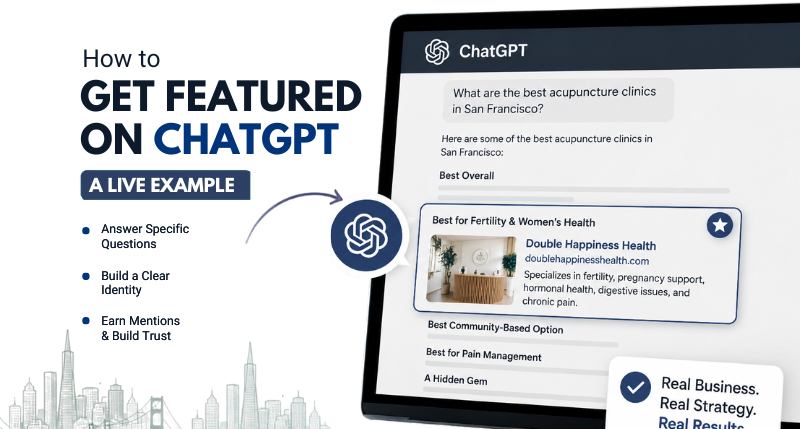
To get featured in ChatGPT answers, your website needs three things: pages that answer specific questions directly, a clear identity that AI models can verify (who you are, where you are, what you specialize in), and mentions on third-party sites that confirm you are real and reputable.
Businesses that nail all three get recommended by name. Businesses that miss even one stay invisible.
That sounds abstract, so let’s make it concrete. Instead of theory, we are going to deep dive into a real business that is featured in ChatGPT for many queries, reverse-engineer exactly why the AI keeps recommending it, and turn that into a playbook you can copy.
The Live Example
We asked ChatGPT:
“What are the best acupuncture clinics in San Francisco?”
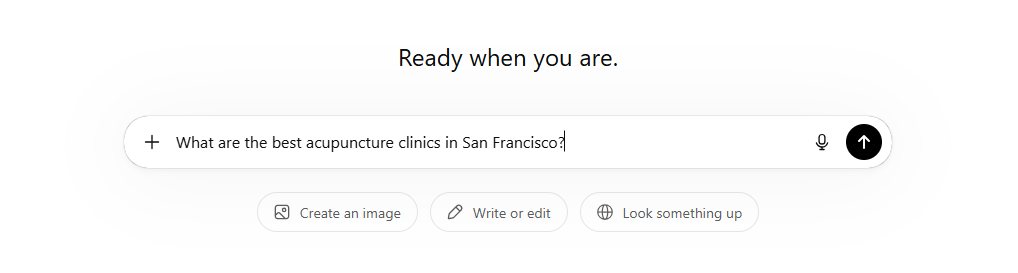
ChatGPT returned a categorized list:
- Best Overall
- Best for Fertility and Women’s Health
- Best Community-Based Option
- Best for Pain Management
- Hidden Gem
Under Best for Fertility & Women’s Health, it named one clinic:
Double Happiness Health (doublehappinesshealth.com)
ChatGPT described it as specializing in fertility, pregnancy support, hormonal health, digestive issues, and chronic pain, integrating traditional Chinese medicine with functional medicine.
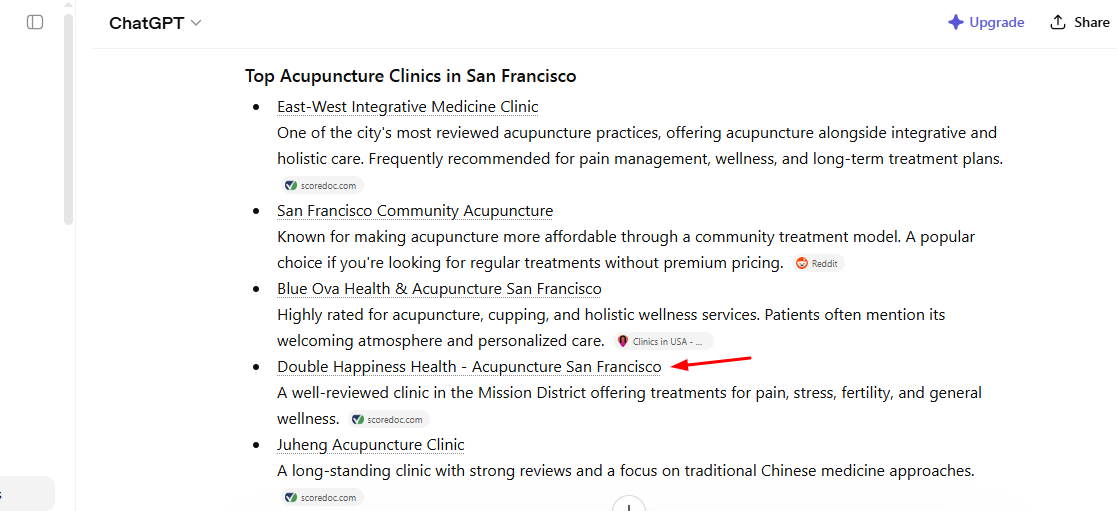
It even cited a third-party source, a health directory, next to the recommendation.
This is a small local clinic, not a hospital chain with a million-dollar marketing budget. So why does the AI trust it enough to recommend it by name?
We went through their website and digital footprint to find out.
Here is what they are doing right.
Why ChatGPT Recommends This Clinic: 7 Things They Got Right
1. Their title tag tells the AI exactly who they are
Their homepage title is:
“Acupuncture San Francisco – Acupuncture for Fertility and Pain in SF Area”
No clever branding, no “Welcome to wellness.”
Service plus city plus specialty, all in one line.
Their meta description does the same job: it states they are a San Francisco acupuncture clinic treating infertility, pain, digestive issues, and women’s health using Chinese medicine.
When an AI model needs to answer “acupuncture for fertility in San Francisco,” this site has already answered the query in its metadata.
That is entity clarity, and it is the cheapest GEO win available.
Your takeaway: Write your title tag as [Service] + [City] + [Specialty]. Save the poetry for your Instagram bio.
2. They built a separate page for every condition they treat
This is the biggest factor, and most local businesses miss it completely.
Most clinics have one generic “Services” page.
This clinic has an entire architecture of condition-specific pages:
- Fertility overview
- PCOS, advanced age and diminished ovarian reserve
- Endometriosis and thin uterine lining
- Miscarriage, unexplained and autoimmune infertility
- IVF, IUI and egg freezing support
- Pregnancy and postpartum
- Male fertility
- Perimenopause, PMS/PMDD, irregular cycles, migraines
Notice how those map to real questions people ask ChatGPT:
- “Can acupuncture help with PCOS?”
- “Does acupuncture improve IVF success rates?”
- “Acupuncture for endometriosis in San Francisco.”
Every one of those questions has a dedicated page waiting to be matched.
Their URLs even include the city:
- /fertility-treatment-san-francisco
- /endometriosis-treatment-san-francisco
The location entity is baked into the page address itself.
Your takeaway: One page per problem you solve. If you treat 12 conditions, you need 12 pages, each answering that condition’s questions directly.
3. Their homepage has a quotable, self-contained paragraph
Right on the homepage, in bold, sits this:
“At Double Happiness Health, we treat a wide range of health challenges, including pain, inflammation, infertility, menstrual disorders, digestive issues, mood, insomnia, fatigue, immunity problems, and other systemic disorders.”
That single sentence lists their entire service range in plain language.
An AI model can lift it as-is and it still makes complete sense out of context.
Compare that to the typical local business homepage that opens with:
“Begin your journey to holistic wellness”
which tells the AI absolutely nothing.
Your takeaway: Every key page needs at least one paragraph that names your business, your location, and exactly what you do, written so it survives being quoted alone.
4. They publish pricing and insurance openly
The clinic has dedicated public pages for pricing, insurance policies, and even a low-income grant program.
Most clinics hide pricing behind “contact us for a quote.”
AI assistants prefer recommending businesses whose practical details they can actually relay.
When a user asks “how much does fertility acupuncture cost in SF,” a site with a public pricing page can be cited.
A site with hidden pricing cannot.
Your takeaway: Publish your prices, your insurance situation, and your booking process. Transparency is now a ranking factor.
5. They run a blog that answers condition-first questions
Their blog is not “clinic news.”
It is a library of answer content:
- Acupuncture for anxiety
- Acupuncture for thin endometrial lining
- How acupuncture supports women during perimenopause
- Chinese medicine for hair thinning in women
- How to improve a thin uterine lining naturally
Each post title is a question or topic a real patient would type into ChatGPT.
This is exactly how a small site builds topical authority around its specialty, and it explains why ChatGPT tagged them specifically as best for fertility and women’s health rather than just listing them generically.
Your takeaway: Blog titles should match the questions your customers ask AI, word for word where possible.
6. Their third-party footprint confirms they are real
The AI does not just take a website’s word for it.
It cross-references.
This clinic shows up in:
- An active Yelp profile linked from their own site
- A “Top 10 Best Acupuncture Centers in San Francisco” listicle on Medium
- Health directories (one of which ChatGPT actually cited as a source in its answer)
- Facebook, Instagram, and TikTok profiles
- A free 15-minute consultation booking system, signaling an operating, accessible business
Independent sources repeating the same story about who you are and what you specialize in is what turns your business from “a website” into “an entity” the AI is confident recommending.
Your takeaway: Get listed in your industry’s directories, earn placements in local “best of” roundups, and keep review platforms active. Five independent mentions beat fifty pages of self-praise.
7. Their business details are consistent everywhere
Their footer carries the full package:
- Street address
- Phone number
matching what appears on their listings.
Consistent name, address, and phone data across the web is a basic local SEO practice, and it directly feeds AI confidence.
Conflicting addresses make models hesitate, and hesitation means someone else gets cited.
Your takeaway: Audit every listing you have. One outdated address on Yelp can quietly cost you AI recommendations.
The Pattern Behind All 7
Look at the list again and a pattern emerges.
Nothing this clinic did is exotic.
There is no secret AI hack, no prompt injection trick, no paid placement.
They simply made themselves extremely easy to understand and easy to verify.
Easy to understand
- Specific pages
- Plain-language descriptions
- Public pricing
- Question-matching blog content
Easy to verify
- Directories
- Reviews
- Listicles
- Consistent contact data
- Active social profiles
ChatGPT recommends them because, when the model goes looking for “fertility acupuncture San Francisco,” this clinic has left clear, consistent, verifiable answers at every place the model checks.
Their competitors left vibes.
Your 30-DayAction Plan
If you run a local or service business and want what this clinic has, here is the order of operations:
Week 1 :
Rewrite your title tag, meta description, and homepage opening paragraph using the [Service] + [City] + [Specialty] formula.
Add your full address and phone to the footer.
Week 2 :
List every problem you solve.
Build or rewrite one page per problem, each opening with a direct, quotable answer and ending with a short FAQ.
Week 3 :
Fix your third-party footprint.
Match your name, address, and phone across:
- Google Business Profile
- Yelp
- Apple Maps
- Your industry directories
Start asking happy customers for reviews at every transaction.
Week 4 :
Publish your pricing page and your first two question-format blog posts based on what customers actually ask you.
Then test it.
Ask ChatGPT, Perplexity, and Gemini the questions your customers ask, once a month, and log who gets named.
AI answers move faster than Google rankings, so the feedback loop on this work is surprisingly quick.
Frequently Asked Questions
Did this clinic pay ChatGPT to be featured?
No. ChatGPT does not sell placement in its answers. The clinic appears because its website and
third-party footprint make it the most verifiable, specific answer to fertility acupuncture queries
in San Francisco.
How long would it take a similar business to get cited?
For a site that is already indexed, long-tail citations (“acupuncture for PCOS in [city]”) can
appear within 4 to 8 weeks of publishing condition pages, since ChatGPT’s search pulls live web
results. Competing for the broad “best [service] in [city]” query usually takes 4 to 6 months of
review building and third-party mentions.
Does this work outside healthcare?
Yes. The same pattern applies to lawyers, accountants, salons, repair services, agencies, and ecommerce. Swap “condition pages” for “problem pages” or “use-case pages” and the playbook is
identical: be specific, be quotable, be verifiable.
Is this a replacement for Google SEO?
No, it builds on it. Everything above also improves Google rankings. The difference is emphasis:
AI visibility rewards direct answers, public details, and entity consistency more heavily than
backlink volume.

Anshul Rana
I’m an SEO, AEO, and GEO specialist who has spent 8+ years getting businesses found online. Whether it’s Google, ChatGPT, Gemini, or Perplexity, I make sure your brand shows up where your customers are searching.
Recent Comments